
Making Disciples
Discipleship That Transforms Individuals, Families, and Nations
Returning to Rwanda is not a program. It is a movement built on the conviction that intentional, relational, biblical discipleship is the most powerful force for lasting change in any society — including Rwanda and all of East Africa.
Our Conviction
Multiplication, Not Addition
Most ministry strategies count decisions. We count disciples. There is a profound difference. A decision can happen in a moment; a disciple is formed over years of intentional, relational investment. We believe the Great Commission is not merely an evangelism mandate — it is a discipleship mandate. Jesus did not say 'make converts.' He said 'make disciples.'
Rooted in Matthew 28 and 2 Timothy 2:2
The Returning to Rwanda model draws from Paul's charge to Timothy: 'And what you have heard from me in the presence of many witnesses entrust to faithful men, who will be able to teach others also' (2 Timothy 2:2). This four-generation vision — Paul — Timothy — faithful men — others — is the structural DNA of our movement. Every discipleship relationship we build is designed to be passed on, not held.
Why Multiplication Changes Everything
Addition-based ministry grows linearly. Multiplication-based ministry grows exponentially. If one disciple-maker invests in two people who each invest in two more, within ten generations that movement reaches over a thousand. This is not theory — it is the pattern of the early church, and it is the pattern Emmanuel Dusabimana has witnessed repeatedly across Rwanda and East Africa. We do not build ministries. We build disciple-makers.
The BLESS Framework
A Practical Posture for Relational Discipleship
BLESS is not a program or formula. It is a way of life — a five-part relational posture that equips every believer to make disciples naturally, in the context of their everyday relationships and communities.
B
Begin with Prayer
Every disciple-making encounter begins in prayer. We do not approach people as projects — we approach them as image-bearers whom God loves and for whom He is already working. Prayer aligns our hearts with His.
L
Listen
Genuine discipleship requires genuine listening. We listen to people's stories, their pain, their questions, and their longings before we ever open our mouths to speak. Listening builds the trust that makes the gospel credible.
E
Engage
We enter people's lives with intentionality and consistency. Engagement means showing up — at the market, in the neighborhood, at the church gathering — with a heart oriented toward deeper relationship and spiritual conversation.
S
Serve
Service is not a strategy for evangelism; it is an expression of Christlikeness. When we serve our neighbors, we embody the kingdom. In Rwanda and East Africa, this takes many forms: practical help, business mentorship, and community development.
S
Share
When the relationship has been built through prayer, listening, engagement, and service, the sharing of the gospel lands in fertile ground. We share not as salespeople but as witnesses — testifying to what we have seen and heard.
The Evergreen Discipleship Guide

A Guide Built for Multiplication
The Evergreen Discipleship Guide is the primary discipleship tool developed by Returning to Rwanda and used by local leaders, church planters, and disciple-makers across Rwanda and East Africa. It is not imported from outside the region — it is contextually crafted, theologically grounded, and designed for the realities of East African church and community life.
What the Guide Contains
The Evergreen Discipleship Guide includes:
- A structured, multi-week journey through the foundations of Christian discipleship
- Scripture-memory anchors and guided reflection questions for each session
- Leader facilitation notes for group and one-on-one contexts
- Multiplication tracks — equipping each disciple to disciple others using the same guide
- Integration with the BLESS framework as a daily relational posture
Used Across Rwanda and East Africa
The guide is currently deployed through trained local leaders in multiple districts of Rwanda and in partner communities across East Africa. Its design prioritizes low-barrier access: it can be used in a home, a church, a marketplace, or under a tree. No classroom required. No seminary degree required. Just a disciple willing to make another disciple.
Ministry Software
Technology in Service of the Kingdom
Returning to Rwanda has developed custom ministry software purpose-built for the needs of church planters and disciple-makers in Rwanda and East Africa. It is not generic church management software. It was designed from the ground up for multiplication-focused, low-resource ministry contexts across the region.
Designed for the Field
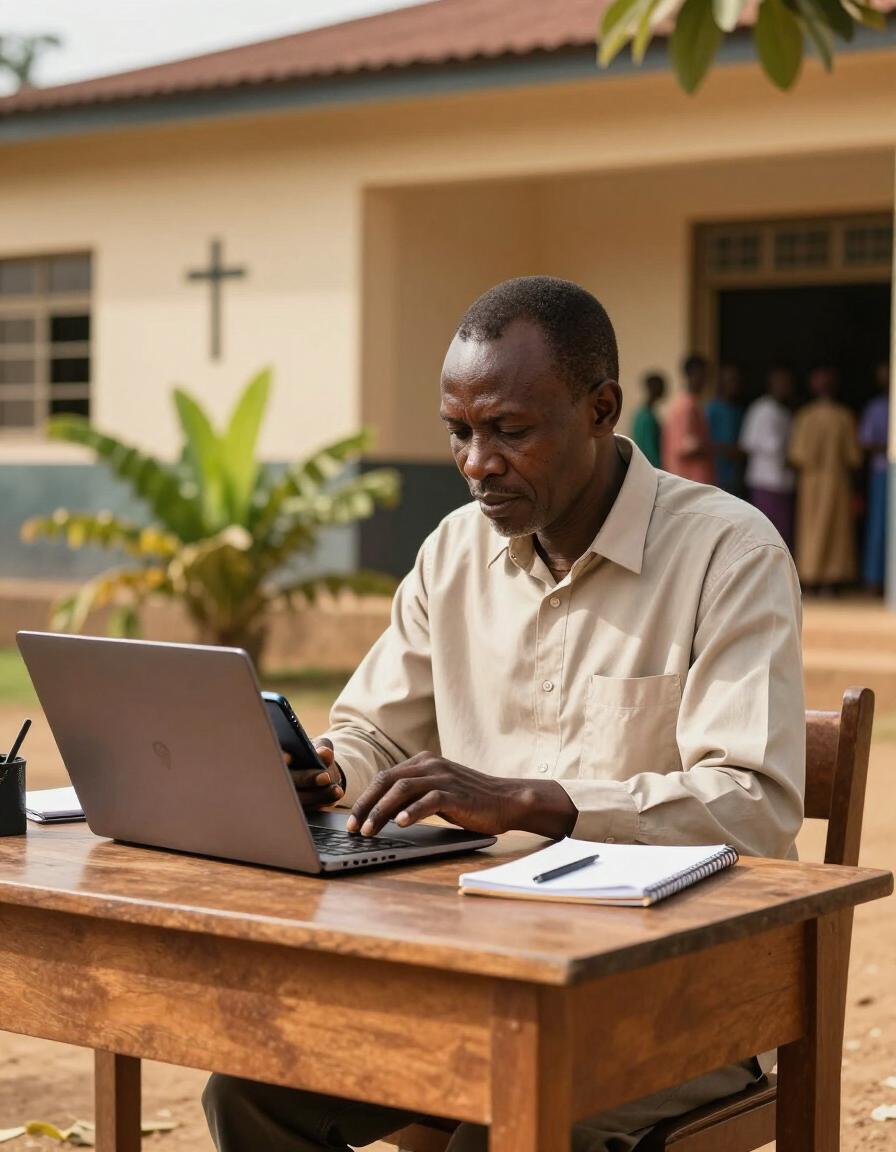
The platform is mobile-first and built to work in low-bandwidth environments, so it functions reliably across Rwanda and East Africa's varied connectivity. It is multilingual by design, supporting local languages alongside English and French to honor the conviction that discipleship formation must happen in the heart language of the community.
Core capabilities include discipleship group tracking and relationship mapping, leader development progress logs, training resource delivery, prayer and care notes, church-planting milestone documentation, permission-based dashboards for different leadership tiers, impact reporting, and responsible data stewardship built in from the foundation. Every feature exists to support what a pastor or disciple-maker is already doing relationally — not to add administrative burden or replace the work of pastoral care.
Common Questions
Questions About the Discipleship Model
Whether you are a pastor, a ministry leader, a student, or someone new to discipleship concepts, these answers are meant to give you a clear starting point for understanding how Returning to Rwanda approaches the Great Commission.
What makes your discipleship model different from other approaches?
Most discipleship programs are structure-first. Ours is relationship-first. The Evergreen Discipleship Guide provides structure, but the engine of our model is a disciple-maker who intentionally invests in a few people with the explicit goal of those people becoming disciple-makers themselves. We prioritize multiplication over addition, depth over breadth, and faithfulness over speed.Who can use the Evergreen Discipleship Guide?
The guide is designed for any believer willing to invest in another person's spiritual growth. It has been used by pastors, lay leaders, marketplace workers, students, and homemakers. No formal theological training is required. What is required is a willing heart and a commitment to show up consistently.Is the Evergreen Discipleship Guide available outside of Rwanda?
Yes. While the Evergreen Discipleship Guide was developed with the Rwandan and East African context in mind, the discipleship principles are universal. We welcome inquiries from ministry leaders in other regions who are interested in adapting or adopting the guide for their context. Please reach out through our Contact page.How does the BLESS framework fit into the guide?
BLESS functions as the daily relational posture that surrounds the guide's more structured content. The guide provides the theological framework and discussion content; BLESS provides the everyday rhythm of living as a disciple-maker in your neighborhood, workplace, and community. They are designed to work together.How do I get training in this discipleship model?
We offer training cohorts for ministry leaders and church planters in Rwanda and East Africa. For those outside the region, we encourage you to connect with us through the Contact page to discuss how partnership or remote training might be possible.
Join the Movement
The Work of Discipleship Needs You
Whether you are called to pray, to partner financially, or to bring your skills and story into the movement — there is a place for you in what God is doing through Returning to Rwanda. Discipleship is not a spectator endeavor. It begins with one person saying yes to another.